Znamenskaya (Vlasyevskaya) tower
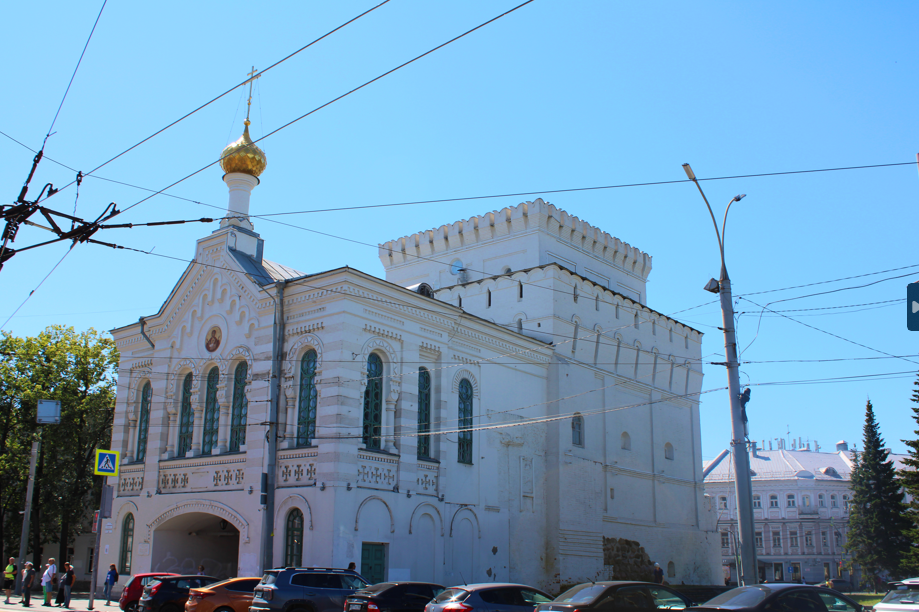


The Vlasyevskaya tower was erected after the "great" fire of 1658 on the site of a wooden one and was part of the fortifications of the Earthen Rampart of Yaroslavl. After the fire of 1658 destroyed the fortifications of the Earthen Rampart of Yaroslavl, by decree of the tsar, 12 deaf and four gate towers were built instead of wooden ones.
In the 19th century, the relevance of defensive towers disappeared, they were dismantled. Two have survived to this day – Arsenalnaya (Volzhskaya) and Znamenskaya (Vlasyevskaya). The Vlasyevskaya Tower was built of brick in 1658-1659 on the site of a wooden tower that burned down in a city fire in the middle of the XVI century. The new tower was a city gate with a watchtower at the top. It was one of the five gate towers, and the road from it led to Uglich. When passing through the gate in Peter's time, a tax was levied on wearing a beard and antique clothes. At the end of the 19th century, according to the design of architect Nikiforov, the Church of the Sign of the Mother of God was added to the Vlasyevskaya Tower, after which the tower later became known. Today, the tower is an object of cultural heritage of federal significance, and the church is of regional significance.
An interesting fact: In 1876, the first water pipeline began to be built in Yaroslavl. The role of the water tower was played by Znamenskaya. In 1883, a water tank with a capacity of 15,000 buckets was reinforced on it. It was enough for a five-kilometer water supply network to supply five hundred out of seven thousand private homes. During the Soviet years, the Yunost National film studio was located here under the leadership of the Honored Worker of Culture of Russia, President of the International Family Film Foundation Ram Yustinov. The studio was the first in the Soviet Union to be awarded the title of People's Studio.